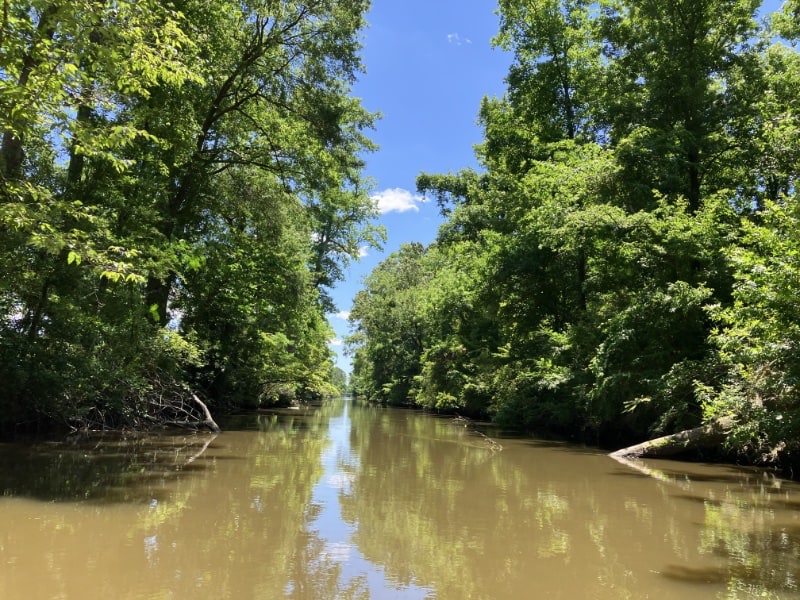
Clubfoot and Harlow Canal
To a greater extent than its neighbors Virginia and South Carolina, North Carolina’s coastal geography has been a challenge to transportation and commerce. A string of barrier islands and sand bars divides the Atlantic Ocean from a series of shallow sounds. Inlets provide access from the ocean to the sounds and the interior areas of the state, via narrow channels.
The Clubfoot and Harlow Canal, first envisioned in the Colonial Era, was part of a larger movement to improve water transportation beginning in the 18th century. The canal was supported through numerous legislative actions and financial assistance from the State of North Carolina, and was championed by the state’s Board of Internal Improvements. After many abortive efforts, the canal opened for small watercraft in 1827. The completion of the nearby Adams Creek Canal in 1910 rendered the Clubfoot and Harlow Creek Canal redundant and gradually irrelevant for significant water traffic. Though eclipsed by railroads and the new canal that was incorporated into the Intracoastal Waterway, the Clubfoot and Harlow Canal is significant as an early public-private partnership in statewide efforts to create improved transportation networks supporting trade and commerce. The canal was originally built largely by enslaved African American labor and is representative of the antebellum contributions of African Americans to the creation of the state’s network of water transportation improvements through particularly arduous labor. During the course of research, partial payment records for enslaved laborers were discovered and their names are recorded in the nomination.
The canal was listed on the National Register in February 2026. The nomination prepared by Hanbury Preservation Consulting can be found here https://www.hpo.nc.gov/nr-nominations/cv1338-cr0565/open